How to Get ChatGPT and Claude to Recommend Your Business, Products and Services
Learn how website structure, useful content, case studies, credible sources and technical access can improve your visibility in ChatGPT and Claude.

Andrew Johnson · · 56 min read ·

Cover image: ChatGPT search launch illustration. Image: OpenAI (2024).
A practical guide to website structure, technical access, useful content, credible evidence and measurement.
Platform information checked November 24, 2026.
A potential customer opens ChatGPT or Claude and describes a problem. They explain what they need, where they operate, what they can spend and what has disappointed them before. Then they ask which business they should contact or which product they should buy.
Does your company become part of that conversation? Is it described accurately? Does the answer explain why your offer fits, or does it send the customer toward a competitor?
These are useful business questions. Answering them requires looking beyond a handful of keywords or a new blog post. Your website needs to explain what you sell. The supporting content needs to answer the questions buyers use to evaluate it. Your claims need evidence. Your information needs to be accessible, consistent and current across the places people and AI systems might encounter it.
To improve your chances of being recommended by ChatGPT and Claude, build a clear and credible body of information about your business, make the relevant pages accessible, connect them around real customer decisions, and measure what the platforms actually say.
There is no guaranteed position to purchase through website optimization. OpenAI says its search results consider relevance and reliability and that placement is not guaranteed. A question, its context and the available sources can change the answer. OpenAI’s explanation of ChatGPT search.
That still leaves substantial work a business can control. This guide explains what that work looks like, how technical and editorial responsibilities differ, and how the different parts of a website should support one another.
Start with the business outcome
Being named in an AI answer is useful only in context. A business that serves Montreal gains little from appearing in a recommendation for a service it does not offer in Vancouver. A product recommendation based on an incorrect claim can create disappointed customers and more support work.
Choose the outcomes that matter: entering the right shortlist, explaining the offer accurately, helping a qualified buyer evaluate it, and making the next step easy.
| What you observe | What it establishes | What it does not establish |
|---|---|---|
| The assistant mentions your brand | Your name appears in that answer | That the mention is positive or suitable for the buyer |
| It cites your website | A page is linked as a source | That your product or service is recommended |
| It recommends your offering | It explicitly suggests the offering as suitable for the stated needs | That every user receives the same recommendation |
| Someone visits your website | A visit occurred that you may be able to attribute | That every AI-influenced buyer clicked a link |
| Someone enquires or buys | A commercial action occurred | That one content change caused it |
A recommendation can rely on a retailer, customer review or independent article instead of your website. Equally, your article might be cited for a definition while another company receives the recommendation. Track these outcomes separately.
What SEO, AEO and GEO mean here
Search engine optimization, or SEO, concerns making websites discoverable and useful in search. Answer engine optimization, or AEO, and generative engine optimization, or GEO, are terms commonly used for improving visibility in answers produced by AI systems. Their definitions overlap and vary between practitioners.
For a business owner, the practical question is the same: can the right customer find accurate, useful information about your offer when making a decision? This guide uses “AI visibility” for that work without treating it as a separate substitute for a sound website, useful marketing and a credible reputation.
How to use this guide
If you own the business or lead marketing, begin with customer questions, website architecture, core pages and supporting evidence. Give the technical section to the person responsible for your website and ask for a completed verification checklist. Work together on the platform setup, measurement and 90-day program.
If you are starting with limited time, select one commercially important offering, five buying questions and the pages that should answer them. Complete that small set before expanding across your entire catalogue.
Where an answer gets its information
An assistant can draw on information learned during model development and, when available and useful, retrieve additional information through tools. For a web-assisted answer, that may involve searches, individual pages and several sources describing the same business. A customer's question, location and other context can affect what is relevant.
ChatGPT documents that it may turn a question into one or more targeted searches. Claude documents using multiple web sources and providing citations in search-based responses. Neither description means that every answer involves a fresh visit to your website. ChatGPT search, Claude search.
This is why website content, external information and supported business-data connections each deserve attention. When reviewing an answer, open the citations and inspect what they actually support. If the answer provides no usable source, record the uncertainty rather than inventing an explanation of where the information came from.
Separate the technical work from the content work
Think of a website as a place a prospective buyer has to navigate. The technical work keeps the doors open, the signs readable and the routes working. The content explains what is available, why it matters, whether it fits and what supports the claims.
Information architecture connects the two. It determines which information belongs on which page and how a visitor can move between those pages.
| Workstream | The question it answers | Typical work | Main responsibility |
|---|---|---|---|
| Technical access and search foundations | Can the intended public information be reached and interpreted? | Crawler access, page delivery, indexing controls, redirects, canonical URLs, language signals, structured data | Website developer or technical SEO specialist |
| Information architecture | Can someone find the right page and understand how it relates to the rest of the business? | Navigation, page hierarchy, service and product categories, content clusters, contextual links | Marketing lead with website strategist |
| Content and evidence | Does the information help a buyer make a sound decision? | Offer pages, comparisons, case studies, expert explanations, tools, policies and factual updates | Marketing with subject-matter experts |
| External representation | Does information elsewhere accurately describe the business? | Reviews, partner profiles, retailer data, editorial coverage and factual corrections | Marketing, communications and account owners |
| Measurement | Are we becoming more accurately visible to relevant buyers, and is it useful? | Repeated observations, source review, referral analysis, enquiries and revenue | Marketing with analytics and sales |
Completing a technical checklist does not supply missing customer evidence. Publishing excellent content does not remove an accidental access block. Treat both as necessary workstreams, and diagnose the actual gap before spending more.
Throughout this guide, platform requirements are linked to official documentation. The recommendations about website architecture and content are Dreww’s practical approach to making information useful and verifiable. They are not a claimed list of secret ChatGPT or Claude ranking factors.
Identify the buying questions worth answering
Start with the decisions customers make before contacting you. Use sales conversations, enquiry forms, support tickets, customer interviews and the questions your team repeatedly answers. Search data can add useful context, but a Google keyword estimate is not a measurement of how often a question is asked inside ChatGPT or Claude.
Group the questions by their purpose:
| Decision | Illustrative customer question | Information needed |
|---|---|---|
| Understand the problem | “Why does my restaurant’s walk-in cooler keep failing?” | Causes, limits of remote diagnosis and next steps |
| Define requirements | “What should a maintenance contract include?” | Scope, exclusions, service arrangements and evaluation criteria |
| Find providers | “Which companies maintain commercial refrigeration in Greater Montreal?” | Service capability, geography and business identity |
| Compare approaches | “Should we repair this equipment or replace it?” | Cost drivers, condition, operating costs and limitations |
| Check suitability | “Can this provider support several restaurant locations in French and English?” | Actual coverage, language capability, capacity and relevant evidence |
| Validate a business | “What evidence supports this company’s experience with grocery stores?” | Specific projects, qualifications and independent information |
These questions are examples, not measured popular prompts. Adapt them to your actual customers and offerings.
Include meaningful constraints: location, budget where appropriate, compatibility, availability, language and the type of customer. A question such as “What is the best company?” gives you much less useful information than one that describes the real buying situation.
Keep questions that name your business separate from questions that require the assistant to discover it. Asking “Why should I hire our company?” is a different test from asking for suitable providers without suggesting a name.
For each priority question, identify the page that should answer it, the evidence needed and the person responsible. This becomes the basis for your content plan. It also makes omissions visible before you commission more articles.
Use the buying-question and content-cluster worksheets to record the mapping. For example, a question about installation cost might map to an existing cost guide, with missing information about electrical work and site preparation assigned to the installation specialist for review. Those are questions to investigate, not assumptions about what every project includes.
Diagnose why you are missing or misrepresented
| What you find | Investigate | First practical response |
|---|---|---|
| Your business is absent from relevant answers | Whether the offer and service area are explicit, the pages accessible and the available sources relevant | Improve the most important missing information and verify access |
| The answer contains incorrect details | The apparent source, old pages, duplicate listings or inconsistent product data | Correct the source you control and request legitimate corrections elsewhere |
| Your website is cited but your offering is not recommended | Whether the cited page answers an informational question or establishes buying suitability | Connect the useful explanation to a clear, relevant offer page |
| A competitor appears repeatedly | The actual claims and sources supporting its inclusion | Identify evidence or information gaps, without copying unsupported claims |
| You receive visits but few qualified enquiries | The intent of the questions, offer fit and next step on the landing page | Improve the customer journey and investigate conversion quality |
Do not assume absence has a single cause. Nor should you accept an assistant’s explanation of “why you ranked” as access to its internal selection process. Use observable pages, answers, citations and technical evidence to decide what to change.
The content side: organize your website around what customers need to understand
Imagine a buyer asks an assistant to recommend a company for a particular job. Your homepage says you provide “innovative solutions.” An old announcement mentions the service the buyer needs. A downloadable brochure gives a different service area. Your best project example is buried in a social media post.
You may have the right capabilities, but the public information makes them difficult to establish.
Information architecture is the way you organize and connect information on your website. A useful structure gives each important question an appropriate home: what you offer, whom it suits, where you operate, what it costs, and what supports your claims.
We recommend treating that structure as part of your AI visibility work. It helps buyers navigate and gives retrieval systems clearer material to work with. It is not a published formula for earning recommendations from ChatGPT or Claude.
Google explicitly describes how links between pages help it understand an ecommerce website. That establishes a search-discovery benefit; it does not establish an identical ranking system across AI platforms. Google’s website-structure guidance.
Give each type of page a clear purpose
Your website needs more than a homepage and a stream of blog posts. It needs the pages appropriate to your actual business and the decisions your customers make.
| Page type | Question it should answer | What to include |
|---|---|---|
| Homepage | What kind of company is this? | A clear business description, primary offerings, customers served, operating geography and links to important sections. |
| About and team pages | Who is responsible for this business and its expertise? | Accurate history, ownership or brand relationships where relevant, real people, applicable experience and verifiable credentials. |
| Service pages | Can this company do the work I need? | Scope, customer fit, exclusions, process, service area, pricing approach, evidence and a relevant next step. |
| Product pages | Is this the right specific product? | Model or identifier, specifications, variants, intended uses, compatibility, availability, price, delivery and support information. |
| Product-category pages | Which products should I consider? | Meaningful product groupings, selection guidance, differences and links to individual products. |
| Industry or use-case pages | Does this offering suit my situation? | Distinct needs, relevant capabilities and examples. Create these when you have useful context to add. |
| Location pages | Can I buy from or work with this business here? | Real locations or service coverage, local contact information, hours and relevant delivery or service conditions. |
| Pricing pages | What will it cost, and what changes the price? | Actual prices where possible; otherwise explain cost drivers, what is included, assumptions and the quoting process. |
| FAQ content | What prevents someone from deciding? | Specific questions beside the relevant offer; a separate FAQ page when it serves a coherent need. |
| Articles and guides | What should I understand before choosing? | Explanations, comparisons, methods, costs, trade-offs and informed answers to customer questions. |
| Case studies | What has this business actually done? | Customer context, work performed, timeframe, evidence, results and limitations. |
| Newsroom and press releases | What happened, and when? | Dated factual announcements, named parties, approved quotes, supporting links and a media contact. |
| Tools and resources | Can this business help me evaluate or complete something? | Working calculators, checklists, templates, reference material and instructions with clear assumptions. |
| Contact and policy pages | How do I proceed, and what terms apply? | Reliable contact routes, support options, purchase policies and the information needed for the next step. |
This is a menu of roles, not a requirement to build every page type. A small specialist business may explain its offering well with a modest website. A retailer with thousands of products needs a different structure. Create a new page when the subject deserves a useful destination of its own.
Core website pages and blog articles do different jobs
Core commercial pages should establish what a customer can buy from you today. Blog content helps the customer learn, compare and decide.
For an illustrative commercial refrigeration business in Greater Montreal, a service page might explain its installation work, equipment types, assessment process, geographical coverage and quoting requirements. An article might explain the differences between a walk-in cooler and a reach-in refrigerator.
The article should link to the relevant installation service when the reader is ready to explore a project. The service page can link back to the comparison where it helps a buyer choose equipment. Neither page needs to copy the other.
The same distinction applies to products. A product page answers questions about a particular model. A buying guide explains how to compare models. A category page helps someone browse the available range. A case study shows a documented application. Each contributes something different.
Give the primary offer a durable page that your team maintains. Do not make a three-year-old blog post the only place describing a service you still sell. If a launch announcement introduced an offering, link it to the current product or service page.
For important commercial pages, check whether a person unfamiliar with your company can identify:
- What is offered, using the words customers use.
- Who it is suitable for, including relevant constraints.
- Where and how it is available.
- What the engagement or purchase involves.
- What evidence supports the claims.
- What to do next.
Replace unsupported adjectives with specific information. “Industry-leading service” tells a buyer little. A truthful explanation of supported equipment, maintenance coverage and response arrangements gives them something they can evaluate. Specificity must come from the business; it should never be invented to make a page sound more persuasive.
Consider this fictional example. The revised wording assumes the business actually delivers the described work:
| Page title | Opening explanation | |
|---|---|---|
| Before | Solutions that work for you | We deliver innovative solutions backed by exceptional service and a commitment to excellence. |
| After | Commercial Refrigeration Installation in Greater Montreal | We plan and install commercial refrigeration systems for restaurants and grocery stores in Greater Montreal. A project begins with a review of your operating needs, proposed equipment and site conditions so we can define the installation scope and prepare a quote. |
The second version gives a reader an offering, customer type, location and first step. The rest of the page still needs scope, limitations, evidence and a useful enquiry route. This is a writing example, not a measured visibility improvement.
Build content clusters around an offering and its buying questions
A content cluster is a group of related pages that help someone understand a subject from different angles. Its purpose is to connect an offering with useful explanations and evidence.
The following example is fictional. These URLs illustrate a proposed structure for a refrigeration company; they are not real pages or evidence of improved AI visibility.
| Proposed URL | Role in the cluster |
|---|---|
/services/commercial-refrigeration-installation/ |
The main commercial destination: scope, fit, process, coverage and project enquiries. |
/guides/choosing-commercial-refrigeration/ |
An educational overview that helps buyers identify the decisions they need to make. |
/guides/walk-in-cooler-vs-reach-in-refrigerator/ |
A comparison of two equipment approaches, including situations where each may be appropriate. |
/guides/commercial-refrigeration-installation-cost/ |
An explanation of cost drivers and what is needed for a meaningful estimate. |
/resources/refrigeration-project-planning-checklist/ |
A practical checklist for gathering project requirements. |
/case-studies/restaurant-refrigeration-installation/ |
A documented project, published only if the business has evidence and permission to share it. |
/services/commercial-refrigeration-maintenance/ |
A related service for ongoing support, with its own scope and conditions. |
The installation page links to the project example as evidence, the cost guide beside its pricing explanation, and the checklist beside the enquiry process. The comparison article links to the installation page where professional assessment becomes relevant. The case study links to the actual service delivered. The planning checklist links to the enquiry route for readers who have assembled their requirements.
That is more useful than attaching the same list of “related posts” to every page.
Sometimes the central page will be a service page. Sometimes a broad educational guide deserves its own overview page. A retailer may use a category page to organize the selection. Choose the structure around the visitor’s task rather than forcing every topic into the same template.
Do not create a separate article for every slight variation of a question. “What does installation cost?” and “How much should I budget for installation?” may be answered best on the same page. Conversely, a detailed maintenance procedure and a service quotation answer different needs.
There is no universal number of supporting articles that makes a cluster complete. Map the significant questions, decide which existing pages can answer them, and create new material only where a useful gap remains.
For an ecommerce business, the same approach might connect a category of commercial upright refrigerators to individual model pages, a buying guide explaining selection criteria, and a documented product test or application. The category organizes the available range. The model page owns the specifications and buying details. The guide explains trade-offs. The test or case study supplies evidence. Link these where they help the customer choose, rather than copying the same description onto all four pages.
Make the relationships visible through navigation and links
Use navigation labels that explain where people are going: Services, Products, Industries, Case Studies, Resources and About. Your business may need fewer sections or different labels, but visitors should not have to interpret internal department names.
A clear path might be Home → Services → Commercial refrigeration installation. A relevant breadcrumb can show that position. An article about refrigeration costs should also be accessible from a useful topic or resource page, rather than disappearing into a date-based archive.
Google recommends descriptive link text and crawlable links. It also notes that products available only through an internal search box may not be discovered by crawling. These are concrete reasons to make important destinations accessible through navigation and contextual links. Google’s link guidance, Google’s ecommerce navigation guidance.
Use link text such as “commercial refrigeration installation costs” when that accurately describes the destination. Avoid filling every link with a long sequence of search terms. The surrounding sentence should explain why the link is useful.
Review orphan pages: pages that exist but have no meaningful links from the rest of the site. Also review categories and tags. A carefully maintained subject collection can help visitors; dozens of overlapping tags containing one or two articles usually create unnecessary navigation choices. Your website specialist can assess their indexing treatment separately.
URL folders alone do not create a connected information structure. Nor does adding every link to the footer. The relationships should make sense on the pages where the reader needs them.
Write articles that resolve real decisions
Choose topics from customer calls, sales objections, support questions, product research and the decisions customers struggle to make. Search data can help identify language and interest, but it should not replace your knowledge of actual buyers.
A useful article should answer its main question early, explain the conditions that change the answer, and provide enough detail to support a decision. Use examples, diagrams, photographs or tables where they make something clearer.
An article about choosing refrigeration equipment could explain capacity, physical access, operating needs and the information a qualified installer will need. It should distinguish general planning guidance from an equipment assessment. The writer should obtain the technical substance from people qualified to provide it.
Avoid publishing interchangeable summaries of material already available everywhere. Add something your business can substantiate: a recurring customer mistake, an explanation from an experienced specialist, an original comparison, a documented process or a useful worksheet.
Length follows the question. A simple compatibility answer may need a short page. A substantial purchasing decision may deserve a detailed guide. Google’s own guidance says its generative search features do not require tiny content chunks or an ideal page length. That statement applies to Google; it is not a universal rule about every AI system. Google’s generative-search guidance.
Use case studies to make capabilities verifiable
A case study should connect a claim about your capabilities to evidence of work you actually performed.
For each case study, record the customer’s initial situation, objective, constraints, work delivered, dates and outcome. Make clear which responsibilities belonged to your team and which belonged to the customer or other partners.
Quantified results need context. State the baseline, measurement period, source of the data and definition of the metric. A reduction in failures during one season is an observation; claiming your work caused every part of that change requires stronger evidence. Do not confuse estimated savings with measured savings, leads with customers, or revenue with profit.
For example, suppose emergency service calls fell from 18 to 12 across two comparable twelve-month periods. Those illustrative numbers support reporting fewer recorded calls. They do not automatically support saying “our maintenance reduced equipment breakdowns by one-third”: calls and breakdowns are different metrics, and other changes could have affected the result. Explain the recorded metric, what changed and what remains uncertain.
Obtain permission to publish identifiable customer details, quotations, photographs and confidential results. If the case must be anonymous, explain the relevant context without inventing a named customer or presenting anonymity as independent validation.
Keep the core story in a readable page. A PDF may be useful for downloading or sharing, but the page should still explain the project, evidence and outcome. Link to the service or product involved, and link back from that offer to the case study where it supports a specific claim.
A small business does not need spectacular numbers. A clearly documented project with useful constraints and lessons can be more informative than a large percentage with no explanation.
The case-study briefing worksheet captures the baseline, measurement source, delivery responsibilities and publication permissions before the story is drafted.
Use press releases for news and distinguish them from independent coverage
A press release provides a dated account of a meaningful development: a product launch, a new location, an acquisition, a partnership or a significant appointment.
Include the actual announcement, dates, named organizations, approved quotations, relevant background and a contact. Explain brand and company relationships clearly where readers could confuse them. Link a new offering to its current commercial page, so the announcement does not become its only permanent description.
Your own newsroom is a source for what your company announced. Independent reporting is a different kind of evidence. If several websites reproduce the same press release, the repetition does not create several independent investigations of its claims.
Distribution can help information reach relevant people, but buying distribution should not be presented as buying AI recommendations. Google’s spam policies also address links inserted into distributed press releases for the purpose of manipulating search rankings. Google’s spam policies.
Preserve the historical date of an announcement. If circumstances change, add a clear correction or update and link to current information. Do not quietly rewrite an old announcement to imply that a past event happened recently.
Build tools and resources people can actually use
Useful resources can demonstrate how your business thinks and help customers make progress. Examples include a project-planning checklist, selection worksheet, specification library, comparison table, implementation template or calculator.
Choose a tool because it solves a recurring customer problem. A calculator that performs a meaningful calculation is more useful than a form labelled “calculator” that only requests an email address.
For a calculator, show the inputs, units, assumptions, calculation method, limitations and an example. Separate user-supplied values from your estimates. Explain when a professional assessment or quote is needed. Review the model when prices, assumptions or operating conditions change.
Provide a readable explanation beside an interactive tool. Someone should be able to understand its purpose and method without running the interface. This also gives search and retrieval systems material that may remain available when an interactive result is not.
If a spreadsheet or template is downloadable, publish enough information on the page to explain its contents and usefulness. Decide deliberately what needs to be gated. Requiring contact details for a particular download may serve a commercial purpose, but it also limits access to that material. Do not put essential service facts exclusively behind the form.
Link resources to the questions they help answer and to the relevant offering. A planning checklist belongs beside project guidance; a product comparison belongs beside the category being evaluated.
Show who knows the subject and how comparisons were made
Use real authors and reviewers when their experience matters. Explain the relevant expertise, and give people a way to understand the business behind the content. Google encourages accurate authorship information and transparency about how substantive content was produced. Google’s helpful-content guidance.
If you compare products or suppliers, identify the criteria, version or model, date and sources. Distinguish first-hand testing from a comparison of published specifications. Disclose relevant commercial relationships and explain who each option suits, including situations where your own offering may not be appropriate.
Google’s review guidance supports evidence of actual experience, useful measurements and balanced discussion of alternatives. These are sound editorial practices; they do not guarantee that an assistant will choose your conclusion. Google’s review guidance.
Maintain a coherent body of information
Assign an owner to important commercial pages, product records, tools and guides. Review them when something changes, not only when someone remembers the blog.
Maintain a shared set of factual business details: names, locations, service areas, contact routes, product identifiers and the relationships between the company, its brands and its offerings. Consistency means avoiding contradictions; it does not require repeating identical paragraphs everywhere.
When auditing existing content, choose among updating, expanding, consolidating, redirecting or retaining it. Two weak articles answering the same question may be better as one useful guide. An old announcement may deserve preservation as history. A discontinued product may need an explanatory page pointing to support or alternatives. Have the website specialist implement redirects and indexing decisions appropriately.
Treat English and French pages as maintained versions of the same business information. Localize terminology and examples, and keep important changes synchronized. Do not let one language advertise a service, price or condition that the other no longer offers.
Finally, resist creating hundreds of nearly identical pages for every town or question variation. Google identifies doorway pages and large amounts of low-value content created to manipulate search as spam. Build location pages where you have meaningful local information and coverage to explain. Google’s spam policies.
Start with the pages closest to an important buying decision. A clear service page, a substantive project example and a useful guide can form a strong first cluster. Expand as your customer questions and evidence justify it.
The technical side: make your public information accessible and dependable
The technical work gives your content a fair opportunity to be found and read. It cannot supply a missing explanation of your services, make an unsupported claim credible or guarantee that an assistant will recommend you.
Start with the pages that matter commercially: your main services, product categories, product pages, locations, pricing, important case studies and strongest resources. A technically accessible archive of weak articles does little to resolve gaps in those pages.
Separate crawling, indexing, retrieval and training
These words describe different processes. Keeping them separate prevents expensive mistakes.
| Process | What it means for your business |
|---|---|
| Crawling | An automated visitor requests a public page or file. |
| Indexing | A search system processes information so it can potentially find it later. |
| Retrieval | A system selects or fetches information while working on a question. |
| Citation | The answer identifies material as a supporting source. |
| Recommendation | The answer explicitly suggests an offering as suitable for the stated needs. |
| Model training | Information may contribute to developing a model's general capabilities or knowledge. |
Seeing a crawler in your server logs does not establish that a page was indexed, cited or recommended. Appearing in a search index does not establish that a particular answer will use the page. Changing a web page also does not instantly rewrite knowledge learned during model training.
OpenAI's own search guidance distinguishes eligibility from placement: making your site accessible creates an opportunity for inclusion, while placement remains unguaranteed. OpenAI's website eligibility guidance.
Give your website specialist a deliberate crawler policy
Search access and training access are separate decisions. Ask the person responsible for your website to document what you intend to allow, then compare that policy with the live settings.
For public pages intended for AI search, have your specialist check access for OAI-SearchBot, Claude-SearchBot and the relevant user-request fetchers while retaining your separate training policy.
| Platform | Search and user-request access | Model-training crawler |
|---|---|---|
| OpenAI | OAI-SearchBot supports ChatGPT search. ChatGPT-User handles certain user-requested visits and does not determine search eligibility. |
GPTBot |
| Anthropic | Claude-SearchBot supports search indexing. Claude-User retrieves content at users' direction. |
ClaudeBot |
OpenAI documents independent controls for search and training. It also notes that robots.txt rules may not apply to user-initiated ChatGPT-User actions. Anthropic documents respect for robots.txt across its named bots and says blocking its search or user-fetch bots may reduce visibility. The controls are not identical across providers. OpenAI crawler documentation, Anthropic crawler documentation.
An audit should examine more than the robots.txt file. A hosting service, content delivery network or web application firewall can challenge or reject a request even when your crawler rules allow it. Check the main domain, relevant subdomains and the actual commercial pages. A successful homepage request says little about a product catalogue blocked elsewhere.
When identifying visitors in logs or configuring exceptions, use the providers' current published verification information. A user-agent name alone can be copied by other clients. Keep changes narrow and retain normal protection for customer accounts, checkout, administration and private data. The goal is reliable access to information you intend to publish.
Check indexing instructions without confusing them with security
A page can be public and readable but carry an instruction asking supporting search engines not to index it. Look for accidental noindex settings in page metadata or response headers, especially after a redesign or migration from a staging site.
Google documents an important distinction: robots.txt controls crawling; it is not a dependable mechanism for removing a URL from search. Google also needs access to a page to read its noindex instruction. These are Google-specific implementation rules, not a promise about every AI retrieval system. Google's robots.txt guidance, Google's noindex documentation.
Ask your developer to identify which exclusions are intentional. An internal search-results page may reasonably be excluded. A key service page accidentally excluded after launch needs attention. Private information should remain protected by authentication and access controls rather than relying on cooperative crawler instructions.
Make essential information available in readable page content
Test what is delivered when a page is requested, not just what appears in your own signed-in browser.
Ask your developer to check response codes, failed redirects, repeated server errors and timeouts on priority pages. Confirm that a successful response contains the actual page, rather than an empty template or error message. Google distinguishes a successful HTTP response from whether the content can actually be indexed. Google’s HTTP response guidance.
For important pages, we recommend making the essential explanation available in the initial HTML where practical. This reduces dependence on a visitor executing scripts, accepting a prompt or interacting with a widget before the information exists. It is a robustness recommendation, not a claim that every assistant is unable to use JavaScript.
Google explicitly documents JavaScript rendering, including the difference between an initial page response and content generated later. That capability should not be assumed identical across search crawlers, assistant fetchers and browser agents. Google's JavaScript documentation.
Check that service descriptions, product specifications, relevant prices and evidence are not available only inside images, videos or interactive elements. Keep those formats when useful, but provide a readable explanation alongside them. An interactive calculator, for example, should have an ordinary page explaining its purpose, inputs, assumptions and method even before somebody runs a calculation.
Provide useful public summaries for gated research and downloads. A PDF can be valuable, but an accessible HTML overview gives visitors another way to understand what the resource contains. Do not assume that removing a gate is always appropriate; choose deliberately which information supports discovery and which requires access.
Make the relationships between pages navigable
Translate the content architecture into working links. For implementation, Google recommends ordinary HTML anchor links with valid destinations and relevant link text. A scripted element that looks like a link is not always equivalent. Google's crawlable-link guidance.
Check filtered listings and pagination as well. If older articles or products become reachable only through an on-site search box, they may be difficult to discover through normal navigation. Test whether a visitor can reach each priority page from a relevant section without knowing its exact address.
Keep URLs, redirects and sitemaps consistent
Choose a preferred address for each important page and use it consistently in internal links and sitemaps. When equivalent content is available at several addresses, ask your developer to review canonical tags, which communicate a preferred version to supporting search engines.
Google treats canonical annotations and redirects as signals, not unconditional instructions. A canonical pointing at the wrong page can undermine your intended organization. It is not a substitute for giving genuinely different pages distinct purposes. Google's canonical URL guidance.
When replacing or moving useful content, preserve a meaningful route to its successor. Avoid sending every removed product, service or article to the homepage. Update internal links as part of the change so visitors do not depend on unnecessary redirect chains.
Maintain a sitemap containing the public pages you want discovered. Google describes sitemaps as a discovery aid and expressly says they do not guarantee crawling or indexing. Use them alongside navigation and contextual links. Review generated sitemaps after adding languages, changing your CMS or reorganizing product categories. Google's sitemap documentation.
Give English and French content proper homes
For a bilingual business, publish each language at a stable address. Make language switching straightforward and preserve the customer's place when a matching translation exists.
Google's hreflang annotations identify corresponding language or regional versions. Implement them consistently, including appropriate return references, and avoid treating a fully translated French page as merely a duplicate of its English counterpart. Google's language-version guidance.
The content also needs localization. Product availability, terminology, service territory, currency and purchasing conditions should match the market served. Translating the navigation while leaving the buying information in another language creates a poor experience even if the technical annotations are valid.
We recommend measuring English and French questions separately. A technically correct language setup is not proof that the business is represented equally well in both languages.
Use structured data to describe facts accurately
Structured data is information in a standardized format that describes what a page contains. Google documents its use for understanding content and supporting eligible enhanced search displays. That does not establish a guaranteed recommendation benefit in ChatGPT or Claude. Google's introduction to structured data.
Relevant types may include:
| Page or subject | Types your developer can assess |
|---|---|
| Company and business identity | Organization, or an appropriate LocalBusiness subtype |
| Product and commercial offer | Product and Offer |
| Service description | Service |
| Article or editorial resource | Article or BlogPosting |
| Navigation hierarchy | BreadcrumbList |
Choose types that fit the actual page and the requirements of the system consuming them. Schema.org defines a broader vocabulary than the set of enhanced search features Google supports; the existence of a type is not evidence of a special Google result or AI recommendation mechanism. Google's supported-feature gallery, Schema.org's Service definition.
Keep names, prices, availability, addresses, authorship and dates consistent with the visible content. Do not invent reviews or place promotional claims only in hidden markup. Google's structured-data policies require relevant, current information that reflects what users can see. Google's structured-data policies.
Validate both the syntax and the facts. A validator can confirm that a field is formatted correctly while the address or price inside it is wrong.
Treat product feeds as maintained business data
If you sell products through a supported integration, a feed can provide information such as product identity, descriptions, images, price and stock. Assign responsibility for keeping that information aligned with the storefront.
OpenAI's current product-feed specification distinguishes products, variants and seller offers, requires current price and availability, and states that search eligibility does not guarantee display. A product in several sizes should not silently inherit the stock status of the wrong variant. OpenAI's product-feed specification.
Treat feed validation, successful ingestion, search eligibility and actual appearance as separate checkpoints. Also distinguish an organic product-data connection from an advertising configuration. OpenAI describes shopping results as separate from ads. ChatGPT shopping documentation.
Do not assume that a feed connected to one platform automatically supplies every assistant. Confirm the integration and its coverage, then test actual products. Requirements and account eligibility can change.
Prioritize usability and reliable delivery
Test the important journey on a phone: read the service information, compare an option, use a tool, open a case study and submit an enquiry. Resolve broken layouts, unreadable tables, obstructive overlays and forms that fail.
Accessibility practices such as useful text alternatives, understandable structure and keyboard operation help more people use the website. Their purpose is broader than search visibility. W3C's introduction to accessibility.
We recommend good performance and accessibility because customers need to use the site successfully. The official sources reviewed do not establish a particular page-speed score or accessibility score as a ChatGPT or Claude recommendation threshold.
Likewise, do not let an llms.txt project displace broken product pages or missing service information. We found no official guarantee that creating this file earns recommendations from either platform. Google explicitly says it does not use such files for search visibility; that statement applies to Google and should not be presented as universal behaviour. Google's AI optimization guidance.
Verify the result at the right level
Ask for evidence against the actual pages that matter:
| Check | What a successful check establishes |
|---|---|
| Page request and delivered content | The tested request received the intended public information. |
| Crawler policy and security logs | The reviewed rules and observed requests show no unintended block for the tested pages and period. |
| Indexing inspection in a search engine's tools | That engine reports a particular indexing state. |
| Structured-data validation and factual review | The markup is valid and matches the page. |
| Feed processing review | The specified records were accepted or are eligible under that integration. |
| Repeated relevant questions in an assistant | What appeared in those recorded tests. |
| Enquiry and sales tracking | Which observable visits or leads produced commercial outcomes. |
Keep those results separate. The technical verification worksheet gives your website specialist a place to record the intended state, evidence and remaining work for each check.
Adapt the priorities to what your business sells
The same foundation applies across industries, but the information that supports a buying decision differs.
| Business model | Core information to prioritize | Useful supporting evidence | Common mistake |
|---|---|---|---|
| Local business | Real locations, service area, hours, contact details, appointment process and qualifications | Current location information, genuine reviews and local project examples | Creating near-identical city pages for areas the business cannot meaningfully serve |
| Professional or B2B service firm | Specific services, customer fit, scope, process, delivery model and pricing approach | Case studies, expert authors, credentials and client-approved examples | Asking articles to explain services that have no useful permanent page |
| Consumer brand or manufacturer | Clear brand identity, product specifications, variants, use cases and where to buy | Testing, product documentation, retailer information and independent reviews | Describing the brand well while leaving individual products difficult to evaluate |
| Ecommerce retailer | Product and category pages, availability, variants, price, shipping, returns and warranty | Accurate supplier data, useful comparisons, relevant reviews and supported feeds | Conflicting stock, price or product identifiers across the site and feeds |
| Software business | Target users, workflows, integrations, implementation, pricing, limits and support | Documentation, product demonstrations, customer outcomes and fair comparisons | Hiding decisive limitations or presenting every plan as suitable for everyone |
| Multi-location or multi-brand business | The relationship between parent company, brands, locations and offerings | Distinct location or brand evidence and consistent official profiles | Making it unclear which entity sells, delivers or supports the offering |
A manufacturer and a retailer should also distinguish their roles. A customer may ask which product to buy and then where to buy it. The best page for the first question may not be the best page for the second.
For regulated products or professional services, have qualified people review the claims customers may rely on. State relevant limitations and evidence accurately. A recommendation built on an exaggerated capability is not a useful business outcome.
Use the business tools each platform actually provides
The website work in this guide applies broadly. The tools available inside ChatGPT and Claude are different. Keep a separate checklist for each platform, and date any instructions that depend on its current features.
ChatGPT: business information, product information and independent answers
OpenAI's Business Hub allows eligible businesses to manage business information and provide product feeds. Its November 19, 2026 update expanded claiming and Business Agent eligibility to ecommerce and online service businesses outside the United States. Business Agents offer customers a separate conversation using a business's information; those conversations are distinct from ChatGPT's independent answers. OpenAI's Businesses in ChatGPT announcement.
Eligibility is not universal. As of November 24, 2026, OpenAI's setup guide says local stores and restaurants can claim only an existing U.S. listing. An eligible online business may have an option to add a missing business. Check the current requirements for your business type and location. Claiming does not guarantee greater visibility or give the owner control over independent recommendations. Setting up your business on ChatGPT.
Our recommendation is to assign an owner to the information you provide. Review the business description, contact details, website, service area, product information and relevant policies whenever they change. Compare them with the website and legitimate external listings. A profile maintained once and then forgotten can become another source of conflicting information.
For a walkthrough of Dreww's setup experience, see Dreww's Business Hub setup guide. Treat the dated walkthrough as an example and check current eligibility and verification instructions for your own account.
Product visibility has another distinction: choosing a product and choosing a merchant selling that product. OpenAI documents product selection using the customer's intent and context, structured product information and other sources. Merchant selection can consider availability, price, quality and whether the merchant is the maker or primary seller. Product results are separate from advertising. Shopping with ChatGPT.
For an online retailer, this makes accurate product information a practical priority. Keep identifiers, variants, prices, stock, shipping and return details consistent across the store and the feeds or integrations you use. Inspect the customer-facing product page as well as the feed. Successful submission is one technical milestone; useful, accurate presentation to a buyer is another.
Advertising should have its own objectives and reporting. OpenAI says ads operate separately and do not influence ChatGPT's answers. Paying for an ad is not a way to purchase an independent recommendation. Ads in ChatGPT. Dreww's article on ChatGPT advertising discusses the investment decision separately.
Claude: focus on accessible evidence and actual search behaviour
Claude's consumer application can use web search, consider multiple sources and cite them. It can also retrieve a specific URL when web retrieval is available. Search behaviour depends on the experience and workspace settings; current documentation also notes that location can inform local results. Claude's web-search guidance.
We have not verified an equivalent public merchant-claiming and product-feed process for Claude in the official documentation reviewed for this guide. Do not assume that a ChatGPT integration also submits information to Claude.
For Claude, prioritize the accessible website, clear offer pages, useful evidence and accurate external coverage described earlier. Test the actual questions a prospective customer could ask. If Claude can summarize a URL you supplied, that establishes a useful access check. It does not establish that Claude would discover or recommend the business without that assistance.
Build evidence beyond your own website
Your website is the information you control. A buyer also needs reasons to believe it.
Start by reviewing the sources appearing in answers to relevant questions. The assistant may recommend a business based on a trade publication, a retailer, a review site or another company's case study. Conversely, it may cite a business's educational article while recommending somebody else's product. Record both the brand discussed and the page cited.
We recommend prioritizing external sources on three grounds: relevance to your buyers, the quality of the information they publish, and the legitimacy of your reason for appearing there. A specialist industry directory with accurate company details may serve your customer better than dozens of unrelated listings.
Useful work can include:
- Correcting an association listing that describes an old service or location.
- Giving authorized retailers complete product specifications and current images.
- Asking customers for honest reviews through a consistent, appropriate process.
- Offering a qualified spokesperson or original findings to a relevant journalist.
- Working with a customer or partner on an accurately documented project story.
- Answering genuine community questions with useful information and clear disclosure of your involvement.
Treat this as reputation and information work. Do not turn it into a quota for links or brand mentions. There is no documented number of reviews, directory listings or press mentions that guarantees selection by either assistant.
In your source audit, group syndicated copies of a press release together. This makes the amount of distinct evidence visible, using the distinction between company announcements and independent reporting explained earlier.
Paid placements and sponsored material should remain identifiable as such. Avoid invented reviews, fabricated experts, hidden instructions aimed at assistants, and mass-produced forum comments. A misleading claim can be repeated as easily as a useful fact; distribution is not a substitute for substantiation.
When an answer is wrong, inspect its sources before deciding what to change. Correct your own page if it is outdated. Ask the relevant publisher to fix an inaccurate listing or article. If appropriate, use the platform's feedback mechanism. Keep a dated record and test again later. A corrected response in your own conversation does not demonstrate that the underlying information has changed for everyone.
Measure what customers can find, then connect it to business results
An answer screenshot is an observation. A useful measurement program produces comparable observations and keeps their limits visible.
Build a small, relevant question set
Use the buyer-question map developed earlier as the basis for the tests. Keep discovery, comparison, suitability and validation questions identifiable, and separate questions that name your business from those that do not.
For the illustrative refrigeration company used in this guide, an unbranded question might be: "Which companies install commercial refrigeration for grocery stores in Greater Montreal?" A branded question asks what a named company offers. The first tests discovery; the second tests representation after the buyer already knows the name.
Keep languages and markets separate. A French question about Montreal and an English question about Canada are not interchangeable observations. Never add a location, qualification or capability to the prompt merely because it improves your company's result.
Separate normal-use tests from deliberate search tests
Run one group using realistic buyer questions without directing the assistant's method. Record whether it searches. This is a sample of the experience produced by those questions under those conditions.
Use a second group that explicitly requests web search to diagnose discoverability in search-based answers. A third, optional access check can supply a specific URL. Keep these groups separate: the assistance you provide changes what the test measures.
Use a fresh conversation for each independent test and document personalization. ChatGPT currently offers an Unpersonalized temporary-chat option that excludes memories, custom instructions and plugins. Temporary chat in ChatGPT. Claude incognito avoids existing memory but can still access profile information such as styles and preferences. Claude incognito guidance.
These controls reduce some sources of variation. They do not create a universal answer that every customer sees.
Keep enough detail to reproduce the observation
Use one row per completed answer, with the following fields:
The answer-observation and reporting worksheets provide templates for these records and for a comparable group of results.
| Field | What to record |
|---|---|
| Test identity | Prompt ID, exact wording, question group and run number |
| Environment | Platform, consumer app or API, visible model, date, language and location |
| Conditions | Search requested, search observed, memory or personalization settings, supplied URLs or files |
| Brand outcome | Absent, mentioned, shortlisted, explicitly recommended, or discouraged |
| Evidence | Exact cited URLs, own-site versus third-party source, saved answer |
| Accuracy | Material correct facts, errors, unsupported claims and important omissions |
| Follow-up | Issue to investigate, owner, change made and review date |
Repeat selected questions on different dates. Retain the original wording for comparisons; add new questions as a separate group when customer needs change. Report failed or unavailable runs separately instead of silently treating them as successful answers without a mention.
If a monitoring provider uses an API, ask which model, search tools, prompts and settings it uses. An API-based test and a consumer-app test are different measurements. Do not label one as a complete representation of the other.
Report rates with transparent denominators
Define the result before counting it. For example, a brand name in a warning is a mention, but it is not a positive recommendation. A source link is a citation, but it is not necessarily an endorsement.
Suppose you complete 30 comparable, unbranded tests in one defined group. Your business is mentioned in 12 answers, recommended in eight, and its website cited in five. Report 12/30 mentions, 8/30 recommendations and 5/30 website citations. Those outcomes can overlap. They describe the tested sample, not a share of all ChatGPT or Claude conversations.
Keep factual accuracy alongside visibility. More frequent recommendations with the wrong service area, invented capabilities or outdated pricing create a different problem from accurate recommendations. Review material errors individually rather than hiding them inside an average score.
For competitor comparisons, use the same prompts and conditions. If you calculate a share metric, define its denominator and whether multiple brands can receive credit in one answer. Avoid treating the first name in a conversational list as a stable search position.
Keep platform reporting, sampled answers and website analytics separate
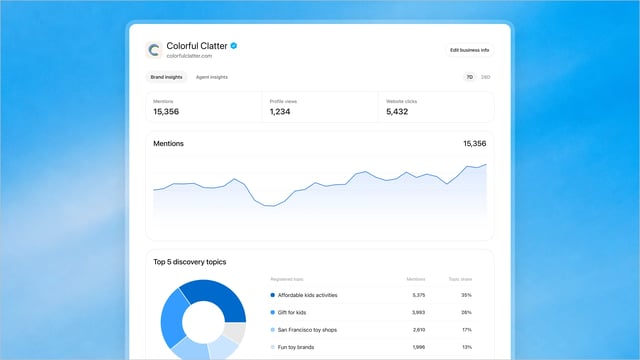
Business Hub reports aggregate activity over the past 28 days. Its definitions matter: for an online business, a reported mention requires a website reference; a brand name alone does not count. For a local business, it means a shown location result. Discovery topics are aggregated themes, not individual prompts or a direct measure of customer intent. Blank metrics can reflect thresholds or unavailable reporting rather than zero activity. OpenAI's Business Hub reporting definitions.
Do not expect those figures to match a manual worksheet that uses a different definition of "mention."
In website analytics, inspect identifiable AI referrals, the pages visited and relevant conversions. Follow qualified enquiries into the CRM to understand whether they become opportunities and customers. Where appropriate, ask new customers how they first heard about you, retaining their answer separately from tracked attribution.
Some people will read an answer and later search for the company, type its address, call or buy elsewhere. Those paths can obscure attribution. Conversely, an AI-referred visit is not automatically a qualified lead. Report what the data establishes and where the route remains uncertain.
A before-and-after improvement is also not proof that one page edit caused it. Record significant website changes, campaigns, product launches and platform changes alongside the results. Use trends to decide what to investigate and improve next.
A practical first 90 days
The schedule below is a way to organize the work. It is not a promised timeline for recommendations or sales.
| Period | Priority | Main owners | Reviewable output |
|---|---|---|---|
| Days 1–30 | Choose relevant buyer questions; establish a baseline; fix incorrect business information and critical access problems | Marketing lead, sales, website specialist | Prompt worksheet, source audit, prioritized issue list and verified fixes |
| Days 31–60 | Improve the most important offer pages; connect supporting articles, resources and case studies; maintain eligible profiles and product data | Marketing, subject experts, web and ecommerce teams | Updated pages with clear ownership, evidence and meaningful internal links |
| Days 61–90 | Address legitimate external information gaps; repeat comparable tests; investigate accuracy and commercial outcomes | Marketing, communications, sales and analytics | Dated results, correction log and next-quarter priorities |
Start with the questions most closely connected to revenue and the pages that should answer them. A smaller set of complete, accurate improvements is easier to assess and maintain than a large publishing schedule with no clear buyer purpose.
Assign an ongoing owner to changing information: hours, services, products, prices, stock, team credentials and policies. Review evergreen guides and case studies when the underlying facts change. Continue investing where the work improves the customer's ability to understand, trust and buy from the business, while measuring whether AI visibility improves along with it.
Common questions and shortcuts to avoid
Do we need to replace SEO with something new?
No. Keep maintaining the website’s search foundations while improving the information that supports customer decisions. AI visibility adds questions about how the business is represented in generated answers. It does not make useful service pages, search accessibility or credible evidence obsolete.
Will creating more blog posts make ChatGPT or Claude recommend us?
Publishing more posts does not, by itself, establish that your business will be recommended more often. First identify a customer question you are not answering well. Sometimes the right fix is a better service page, an updated product specification, a case study or a correction to a third-party listing. Publishing another general article may leave the actual gap untouched.
Does every question require a separate page?
No. Several related questions can belong on one substantial page. Create a separate page when it serves a distinct purpose and you have useful, specific information to put there. Splitting one answer across dozens of thin pages can make the website harder to navigate and maintain.
Does being first on Google mean we will be recommended?
A Google position is an observation about a particular Google result. It does not establish the answer ChatGPT or Claude will produce for a different question and context. Track traditional search performance and AI answer observations separately.
Can we pay for an unpaid recommendation?
Paid advertising, sponsored content and independent recommendations are different categories. Treat advertising as a paid acquisition decision. Do not interpret an ad campaign, a paid directory package or a sponsorship as a guarantee that the assistant will independently recommend your business.
Will schema, an AI plugin or an llms.txt file solve this?
Ask what specific problem the proposed tool solves and how success will be verified. Valid structured data can help describe information for systems that use it; a file or plugin cannot supply missing evidence or guarantee selection. The technical section explains the documented roles and limits.
Can we teach the platforms about our business by repeatedly describing it in chats?
Do not treat a private conversation, uploaded brochure or custom assistant as a public business submission process. It may help that particular interaction use the information, but it is not proof that unrelated customers will see it. Use public, accurate sources and supported business-data features for the purposes they actually document.
Should we use AI to write the content?
AI can help organize research, identify missing questions, draft explanations and check consistency. People with real knowledge still need to supply and verify the facts. Do not invent customer quotes, project results, product tests, qualifications or experience. Publishing faster only helps if the result is accurate and useful.
Do social followers, backlinks or press mentions guarantee recommendations?
No single number establishes that outcome. Evaluate whether the source is relevant, accessible, trustworthy and actually useful to the customer’s decision. A small amount of specific evidence can be more valuable to a buyer than a large volume of generic promotion. That is a content-quality judgment, not a claimed numerical weighting inside either platform.
How long will it take?
Separate implementation from discovery and outcomes. Your team can set a date to repair a broken page or publish a complete case study. It cannot promise when an external system will retrieve it, which questions will use it or whether it will lead to a sale. Use the 90-day program as a work and review schedule, then adjust based on the evidence.
What if an answer gets our business wrong?
Save the question, answer, date and cited sources. Correct inaccurate information on your own pages, profiles and feeds. Where the source is external, request a factual correction from the publisher. Use platform feedback where available, then recheck. A corrected answer in one conversation is not confirmation that every future answer has changed.
Give customers a clear reason to choose you
The work starts with a practical question: if someone unfamiliar with your business wanted to decide whether you were suitable, could they find the information and evidence they needed?
Build a website that answers that question well. Make the core pages useful. Connect the supporting articles, case studies, resources and tools to the offerings they explain. Keep the technical access working, the facts consistent and the evidence current. Then observe how ChatGPT and Claude represent the business and use those findings to improve the information further.
If potential customers are researching your category in ChatGPT or Claude, book a call with Dreww to discuss what they are finding and where this work fits into your broader marketing strategy.
Planning and measurement worksheets
Companion to Dreww's guide, How to Get ChatGPT and Claude to Recommend Your Business, Products and Services. These are blank working templates with explicitly labelled examples. They contain no measured performance results.
Copy the relevant template into your team's document or spreadsheet. Start with one important offering and five buyer questions. Add more detail only when it helps someone make a decision or complete the work.
1. Map a buying question to a useful page
| Field | Your entry |
|---|---|
| Offering and target customer | |
| Market and language | |
| Exact customer question | |
| Evidence that customers ask it | Sales call, enquiry, support request, research or other source |
| Buying stage | Discovery / requirements / comparison / validation / purchase |
| Existing page that should answer it | |
| Intended page role | Service / product / category / article / case study / tool / other |
| Missing information | |
| Evidence required | |
| Subject-matter expert | |
| Content owner and review date | |
| Next step for the reader |
Illustrative example: a buyer asking about installation costs may need a cost guide linked to a commercial installation service page. The guide explains cost drivers; the service page explains the actual offer and enquiry process. This is a proposed page relationship, not an observed result.
2. Plan a content cluster
| Page | Main job | Question answered | Evidence to include | Link to next useful page | Owner |
|---|---|---|---|---|---|
| Core service or product/category page | Explain the offer | ||||
| Educational overview | Help the buyer define the decision | ||||
| Comparison or cost guide | Explain alternatives or economics | ||||
| Case study | Show relevant work and results | ||||
| Tool or resource | Help the buyer evaluate or prepare |
These rows are optional roles. Do not create a page solely to fill a row. Consolidate overlapping questions when one strong page can answer them well.
3. Brief a case study
| Field | Your entry |
|---|---|
| Customer, industry and context | |
| Publication permission and restrictions | |
| Initial problem and relevant constraints | |
| Objective | |
| Work delivered by your team | |
| Work delivered by the customer or partners | |
| Start and end dates | |
| Baseline and comparison period | |
| Metric definition and unit | |
| Source of each numerical claim | |
| Result: measured, estimated or projected | |
| Other factors that could explain the result | |
| Approved customer quotation and attribution | |
| Images or documents with permission | |
| Service or product page to link | |
| Reviewer and review date |
Describe what the evidence supports. Do not present estimates as measured results or imply that your work caused every observed change.
4. Brief a useful calculator or resource
| Field | Your entry |
|---|---|
| Customer task | |
| Intended user | |
| Inputs, units and accepted ranges | |
| Formula, method or decision criteria | |
| Source and date for assumptions | |
| Example input and expected output | |
| Missing-input and invalid-input behaviour | |
| Limits and when an expert assessment is needed | |
| Public explanation available without running the tool | |
| Download or access requirements | |
| Relevant service or product link | |
| Technical owner and subject reviewer | |
| Trigger for updating the assumptions |
Test the calculation against an independent worked example. A calculator that returns a value is not necessarily returning a useful or correct value.
5. Ask for technical evidence
| Item | Intended state | Evidence or result | Owner | Follow-up date |
|---|---|---|---|---|
| Priority public pages | Listed and reachable | |||
| Search-crawler policy | Deliberate and documented | |||
| Training-crawler policy | Decided separately | |||
| Hosting and security controls | No unintended blocks on intended public pages | |||
| Indexing instructions | No accidental exclusions | |||
| Initial and rendered page content | Important information available as intended | |||
| Navigation and contextual links | Important destinations discoverable | |||
| Canonicals and redirects | Consistent with page purpose | |||
| Sitemap | Appropriate current public URLs | |||
| Language versions | Stable URLs and matching information | |||
| Structured data | Valid and factually consistent | |||
| Product integration, where applicable | Processing and eligibility checked separately | |||
| Mobile journey and forms | Tested through completion |
“Not checked” is different from “passed.” A page access test, an indexing report and a recommendation observed in an assistant establish different things.
6. Record one AI-answer observation
Use one completed record for each answer. Do not replace a disappointing result with a favourable rerun; save both as separate observations.
| Field | Your entry |
|---|---|
| Prompt ID and exact wording | |
| Brand named in prompt? | Yes / No |
| Test group | Normal buyer use / Search explicitly requested / Specific URL supplied |
| Platform and surface | Consumer app / API / Monitoring provider |
| Visible model and version | Record what is shown; do not infer |
| Date and time | |
| Language and geographic context | |
| Personalization, memory and relevant workspace settings | |
| Search observed? | Yes / No / Unclear |
| URLs, files or extra context supplied | |
| Run status | Completed / Failed / Unavailable |
| Brand outcome | Absent / Mentioned / Shortlisted / Recommended / Discouraged |
| Website cited? | Yes / No |
| Exact cited URLs and relevant claims | |
| Material factual errors or omissions | |
| Other businesses presented | |
| Saved answer or evidence reference | |
| Investigation or next action |
Define “recommended” before scoring. An incidental mention and an explicit recommendation should not silently become the same metric.
7. Summarize a comparable group of observations
| Field | Your entry |
|---|---|
| Period and prompt group | |
| Platform, surface, market and language | |
| Number of planned observations | |
| Completed observations | |
| Failed or unavailable observations | |
| Answers mentioning the business | Count / completed observations |
| Answers recommending the business | Count / completed observations |
| Answers citing the business's website | Count / completed observations |
| Material errors found | List or count with definitions |
| Important changes since the comparison period | |
| What the sample supports | |
| What remains uncertain |
Illustrative arithmetic only: eight recommendations in 30 completed observations is 8/30, approximately 26.7%. It is not 26.7% of all customer conversations. Mention, recommendation and citation counts can overlap.
Keep Business Hub reporting separate because its definitions and reporting window differ. Keep referral sessions, enquiries, opportunities, purchases and revenue separate from the answer observations. Preserve tracked attribution and customer-reported discovery as distinct evidence.
8. Keep a correction and maintenance log
| Date found | Incorrect or outdated fact | Source URL or record | Evidence for correction | Owner | Action taken | Rechecked date and result |
|---|---|---|---|---|---|---|
Use this for your website, profiles, product records and external information. Correcting a source does not establish when every downstream answer will reflect the correction.
Share this story